×
Request Free Sample ×

Kindly complete the form below to receive a free sample of this Report

Leading companies partner with us for data-driven Insights

clients tt-cursor
Hero Background

UK Incident Emergency Management Market

ID: MRFR/ICT/58280-HCR
200 Pages
Aarti Dhapte
October 2025

UK Incident Emergency Management Market Research Report By Solution (Geospatial Technology Solution, CBRNE/Hazmat Solution, Situational Awareness Solution), By System (Simulation Systems) and By Professional Service (Training, Consultant)-Forecast to 2035

Share:
Download PDF ×

We do not share your information with anyone. However, we may send you emails based on your report interest from time to time. You may contact us at any time to opt-out.

UK Incident Emergency Management Market Infographic
Purchase Options

UK Incident Emergency Management Market Summary

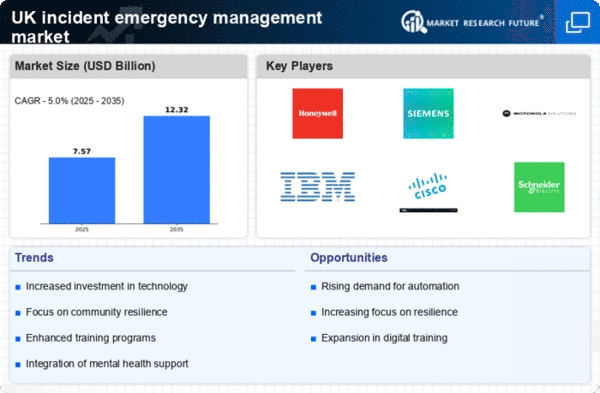
As per MRFR analysis, the UK incident emergency-management market size was estimated at 7.21 USD Billion in 2024. The UK incident emergency-management market is projected to grow from 7.57 USD Billion in 2025 to 12.32 USD Billion by 2035, exhibiting a compound annual growth rate (CAGR) of 5.0% during the forecast period 2025 - 2035.

Key Market Trends & Highlights

The UK incident emergency-management market is evolving towards greater technological integration and community engagement.

  • Technological integration is becoming increasingly prevalent, enhancing response capabilities and efficiency.
  • Community engagement initiatives are gaining traction, fostering collaboration between authorities and the public.
  • Regulatory developments are shaping the landscape, ensuring compliance and promoting best practices in emergency management.
  • Increased investment in infrastructure and growing public awareness are driving market growth, alongside advancements in technology and data analytics.

Market Size & Forecast

2024 Market Size 7.21 (USD Billion)
2035 Market Size 12.32 (USD Billion)
CAGR (2025 - 2035) 5.0%

Major Players

Honeywell (US), Siemens (DE), Motorola Solutions (US), IBM (US), Cisco Systems (US), Schneider Electric (FR), Raytheon Technologies (US), Northrop Grumman (US), General Dynamics (US)

UK Incident Emergency Management Market Trends

The incident emergency-management market is currently experiencing a transformative phase. This transformation is driven by advancements in technology and an increasing emphasis on preparedness. Authorities are prioritizing the integration of innovative solutions, such as artificial intelligence and data analytics, to enhance response strategies. This shift appears to be influenced by the growing complexity of emergencies, necessitating a more proactive approach to incident management. Furthermore, collaboration among various stakeholders, including government agencies and private organizations, is becoming more pronounced, fostering a unified response framework. In addition, the focus on community resilience is gaining traction, as local entities recognize the importance of engaging citizens in emergency preparedness initiatives. This trend suggests a shift towards a more inclusive model, where public awareness and education play crucial roles in mitigating risks. As the landscape evolves, The incident emergency-management market will adapt, reflecting the changing needs and expectations of society. The ongoing development of regulatory frameworks and funding mechanisms may further shape the market dynamics, ensuring that resources are allocated effectively to enhance overall safety and security.

Technological Integration

The incident emergency-management market is witnessing a notable trend towards the integration of advanced technologies. Tools such as artificial intelligence, machine learning, and data analytics are being adopted to improve decision-making processes during emergencies. This technological shift aims to enhance situational awareness and streamline communication among responders, ultimately leading to more effective incident management.

Community Engagement

There is a growing emphasis on community engagement within the incident emergency-management market. Local authorities are increasingly recognizing the value of involving citizens in preparedness efforts. This trend indicates a shift towards fostering resilience at the community level, where public education and participation are seen as vital components in reducing vulnerability to emergencies.

Regulatory Developments

Evolving regulatory frameworks influence the incident emergency-management market. Recent initiatives by government bodies aim to establish clearer guidelines and standards for emergency response. These developments suggest a concerted effort to enhance coordination among various stakeholders, ensuring that resources are utilized efficiently and effectively during incidents.

UK Incident Emergency Management Market Drivers

Increased Investment in Infrastructure

The incident emergency-management market in the UK is experiencing a notable surge in investment aimed at enhancing infrastructure resilience. Government initiatives, such as the National Resilience Strategy, have allocated substantial funding to improve emergency response capabilities. This includes upgrading communication systems and emergency services facilities, which are crucial for effective incident management. The UK government has committed over £1 billion to bolster infrastructure against potential threats, indicating a strong focus on preparedness. As a result, the incident emergency-management market is likely to benefit from these investments, fostering innovation and the adoption of advanced technologies. Enhanced infrastructure not only improves response times but also increases public confidence in emergency services, thereby driving demand for comprehensive incident management solutions.

Growing Public Awareness and Preparedness

Public awareness regarding emergency preparedness is steadily increasing in the UK, significantly impacting the incident emergency-management market. Campaigns aimed at educating citizens about disaster readiness and response strategies have gained traction, leading to a more informed populace. According to recent surveys, approximately 70% of UK residents now acknowledge the importance of being prepared for emergencies. This heightened awareness is likely to drive demand for training programs and resources, as individuals seek to equip themselves with the necessary skills to respond effectively. Consequently, the incident emergency-management market is poised to expand as organizations develop tailored solutions to meet the needs of a more proactive public, fostering a culture of preparedness across communities.

Climate Change and Environmental Challenges

The increasing frequency of extreme weather events in the UK, attributed to climate change, is significantly influencing the incident emergency-management market. Flooding, storms, and heatwaves are becoming more prevalent, necessitating enhanced emergency response strategies. The UK government has recognized this challenge, allocating over £400 million for flood defense and resilience projects. This funding is aimed at improving infrastructure and response capabilities to mitigate the impacts of climate-related incidents. As environmental challenges continue to escalate, the incident emergency-management market is likely to expand, driven by the need for innovative solutions that address these emerging threats. Organizations are expected to invest in adaptive technologies and training programs to better prepare for and respond to climate-induced emergencies.

Legislative Support for Emergency Management

The legislative framework surrounding emergency management in the UK is evolving, providing robust support for the incident emergency-management market. Recent legislative measures have reinforced the responsibilities of local authorities and emergency services in disaster preparedness and response. The Civil Contingencies Act mandates that local councils develop comprehensive emergency plans, thereby creating a structured approach to incident management. This legal backing is likely to stimulate demand for specialized services and products within the market, as organizations seek to comply with regulatory requirements. Furthermore, the emphasis on collaboration among agencies is fostering partnerships that enhance resource sharing and operational efficiency. As a result, the incident emergency-management market is expected to grow in response to these legislative developments.

Advancements in Technology and Data Analytics

Technological advancements are playing a pivotal role in shaping the incident emergency-management market in the UK. The integration of data analytics, artificial intelligence, and machine learning into emergency response systems is enhancing decision-making processes. For instance, predictive analytics can forecast potential incidents, allowing for preemptive measures to be taken. The UK government has invested approximately £500 million in technology upgrades for emergency services, indicating a commitment to leveraging innovation for improved outcomes. These advancements not only streamline operations but also facilitate real-time communication and coordination among various agencies. As technology continues to evolve, the incident emergency-management market is likely to witness increased adoption of sophisticated tools that enhance overall efficiency and effectiveness in managing emergencies.


Market Segment Insights

By Solution: Geospatial Technology Solutions (Largest) vs. Situational Awareness Solutions (Fastest-Growing)

In the UK incident emergency-management market, Geospatial Technology Solutions command a significant share, underscoring their crucial role in mapping and managing emergency responses. These solutions facilitate spatial analysis and enhance coordination efforts during crisis situations, making them an indispensable tool for emergency management agencies. Meanwhile, Situational Awareness Solutions are rapidly gaining traction, driven by the increasing need for real-time information and analytics in emergencies, which positively impacts their adoption rates. The growth of the UK incident emergency-management market is significantly influenced by advancements in technology and the escalating frequency of emergencies that require immediate response. Factors such as the integration of artificial intelligence and improved communication systems bolster the efficacy of both Geospatial Technology and Situational Awareness Solutions. This growth trend is particularly evident in Situational Awareness Solutions, which are leveraging innovative technologies to provide comprehensive views of incidents, thus attracting new investments and interest from various sectors.

Geospatial Technology Solutions (Dominant) vs. CBRNE/Hazmat Solutions (Emerging)

Geospatial Technology Solutions currently hold a dominant position in the UK incident emergency-management market due to their essential contributions to situational analysis and strategic planning in emergency response efforts. Their capability in visualizing data spatially allows for more effective decision-making and resource allocation during crises. In contrast, CBRNE/Hazmat Solutions are emerging with growing importance, particularly as incidents involving chemical, biological, radiological, nuclear, and explosive materials gain attention. While still a developing segment, CBRNE/Hazmat Solutions are evolving to meet stringent safety regulations and enhancing emergency preparedness. As demand increases for specialized response capabilities, these solutions are poised to play an increasingly vital role in supporting the demands of modern emergency management.

By System: Simulation Systems (Largest) vs. Training Systems (Fastest-Growing)

In the UK incident emergency-management market, Simulation Systems command significant market share, driven by their efficacy in training personnel for real-life crisis scenarios. These systems are preferred for their capability to provide immersive and realistic training experiences that lead to better preparedness among emergency responders. This has made them a staple in many organizations focused on enhancing their readiness strategies. On the other hand, Training Systems are emerging rapidly due to the increasing need for cost-effective training solutions that can be deployed remotely. The growth in digitalization and the need for flexible training methods are further accelerating the adoption of these systems. This trend indicates a shift towards more accessible training options, reflecting the evolving dynamics of the emergency management landscape.

Simulation Systems (Dominant) vs. Training Systems (Emerging)

Simulation Systems are characterized by their ability to create realistic environments for emergency management training and assessment. As the dominant segment, they offer advanced features such as scenario customization and real-time feedback, which enhance the learning experience. Conversely, Training Systems are emerging as cost-effective alternatives that focus on flexible, remote training solutions. While they may not match the immersive experience provided by Simulation Systems, their growing adoption highlights a trend towards accessibility and convenience in training. The competitive landscape is thus evolving as both segments cater to the varying needs of organizations committed to improving their emergency preparedness.

By Professional Service: Training (Largest) vs. Consultants (Fastest-Growing)

In the UK incident emergency-management market, the professional service segment is primarily dominated by training services, which hold the largest share due to the increasing need for well-prepared personnel in emergency situations. Consultants also have a significant presence, but they are witnessing faster growth as organizations seek expert advice on compliance and strategic initiatives, especially following recent regulatory changes. The growth trends in this segment are driven by heightened awareness of emergency preparedness and the necessity for organizations to comply with evolving standards and regulations. Training services are benefiting from increased investments in workforce development, while consulting services are emerging rapidly as businesses recognize the value of tailored strategies to enhance their emergency management capabilities and minimize risks.

Training (Dominant) vs. Consultants (Emerging)

Training services are currently the dominant force in the professional service segment, characterized by structured programs aimed at developing specific skills that enhance effective emergency response. These services are essential for ensuring that personnel remain capable and knowledgeable, thus reducing the risks associated with emergency situations. On the other hand, consultants represent an emerging segment, specializing in offering strategic guidance and expert advice tailored to unique organizational needs. Their rapid growth can be attributed to the increasing complexity of regulatory environments and the desire of organizations to adopt best practices in incident management, allowing them to navigate challenges with more expertise.

Get more detailed insights about UK Incident Emergency Management Market

Key Players and Competitive Insights

The incident emergency-management market is characterized by a dynamic competitive landscape, driven by the increasing need for effective response mechanisms to various emergencies. Key players are focusing on innovation, digital transformation, and strategic partnerships to enhance their operational capabilities. Companies such as Honeywell (US), Siemens (DE), and Motorola Solutions (US) are at the forefront, leveraging advanced technologies to improve incident response times and operational efficiency. Their strategies not only reflect a commitment to technological advancement but also indicate a broader trend towards integrated solutions that combine hardware and software for comprehensive emergency management.

In terms of business tactics, companies are increasingly localizing manufacturing and optimizing supply chains to enhance responsiveness and reduce costs. The market appears moderately fragmented, with a mix of established players and emerging firms vying for market share. The collective influence of these key players shapes a competitive environment where innovation and customer-centric solutions are paramount, allowing them to differentiate themselves in a crowded marketplace.

In October 2025, Honeywell (US) announced the launch of a new cloud-based incident management platform designed to streamline communication and coordination during emergencies. This strategic move is significant as it aligns with the growing trend towards digital solutions that enhance situational awareness and decision-making capabilities for emergency responders. By integrating advanced analytics and real-time data sharing, Honeywell aims to position itself as a leader in the digital transformation of emergency management.

In September 2025, Siemens (DE) expanded its partnership with local authorities in the UK to implement smart city technologies that enhance emergency response capabilities. This collaboration is crucial as it underscores Siemens' commitment to leveraging IoT and AI technologies to create more resilient urban environments. The strategic importance of this partnership lies in its potential to improve real-time data collection and analysis, thereby enabling quicker and more effective responses to incidents.

In August 2025, Motorola Solutions (US) launched a new suite of AI-driven analytics tools aimed at improving situational awareness for public safety agencies. This initiative reflects a broader trend towards the integration of artificial intelligence in emergency management, suggesting that Motorola is keen to capitalize on the growing demand for data-driven decision-making tools. The strategic importance of this development is evident in its potential to enhance operational efficiency and effectiveness in emergency response scenarios.

As of November 2025, current competitive trends in the incident emergency-management market are heavily influenced by digitalization, sustainability, and AI integration. Strategic alliances are increasingly shaping the landscape, allowing companies to pool resources and expertise to deliver more comprehensive solutions. Looking ahead, competitive differentiation is likely to evolve from traditional price-based competition towards a focus on innovation, technology, and supply chain reliability. This shift indicates a growing recognition that the ability to provide cutting-edge solutions will be paramount in maintaining a competitive edge in the market.

Key Companies in the UK Incident Emergency Management Market market include

Industry Developments

The UK Incident Emergency Management Market has observed significant developments recently, including increased investments in digital solutions to enhance emergency response capabilities. Companies like Palantir Technologies and Honeywell have been focusing on advanced analytics and AI-driven decision-making tools to optimize response strategies. In September 2023, Everbridge announced strategic partnerships to improve critical event management platforms, further highlighting the shift towards integrated technologies in emergency management.

Another notable event is the ongoing collaboration between PwC and the UK government to bolster pandemic preparedness, aiming to support local authorities. In terms of mergers and acquisitions, KPMG's acquisition of consultancy firms in July 2023 positioned them to expand their risk management offerings in the UK.

The growth of the market valuation for companies like Siemens and Cisco Systems has also been notable, driven by the increasing demand for smart technologies and digital infrastructure to manage incidents efficiently. Furthermore, the heightened focus on cybersecurity and resilience in the wake of recent regional crises has underscored the necessity for organizations such as Deloitte and IBM to enhance their service offerings, contributing to a robust market landscape.

Future Outlook

UK Incident Emergency Management Market Future Outlook

The Incident Emergency Management Market is projected to grow at a 5.0% CAGR from 2024 to 2035, driven by technological advancements, regulatory changes, and increasing public safety awareness.

New opportunities lie in:

  • Development of AI-driven incident response platforms
  • Integration of IoT devices for real-time monitoring
  • Expansion of training programs for emergency personnel

By 2035, the market is expected to be robust, reflecting substantial growth and innovation.

Market Segmentation

UK Incident Emergency Management Market System Outlook

  • Simulation Systems

UK Incident Emergency Management Market Solution Outlook

  • Geospatial Technology Solutions
  • CBRNE/Hazmat Solutions
  • Situational Awareness Solutions

UK Incident Emergency Management Market Professional Service Outlook

  • Training
  • Consultants

Report Scope

MARKET SIZE 2024 7.21(USD Billion)
MARKET SIZE 2025 7.57(USD Billion)
MARKET SIZE 2035 12.32(USD Billion)
COMPOUND ANNUAL GROWTH RATE (CAGR) 5.0% (2024 - 2035)
REPORT COVERAGE Revenue Forecast, Competitive Landscape, Growth Factors, and Trends
BASE YEAR 2024
Market Forecast Period 2025 - 2035
Historical Data 2019 - 2024
Market Forecast Units USD Billion
Key Companies Profiled Honeywell (US), Siemens (DE), Motorola Solutions (US), IBM (US), Cisco Systems (US), Schneider Electric (FR), Raytheon Technologies (US), Northrop Grumman (US), General Dynamics (US)
Segments Covered Solution, System, Professional Service
Key Market Opportunities Integration of advanced technologies enhances response efficiency in the incident emergency-management market.
Key Market Dynamics Growing emphasis on technology integration enhances incident response efficiency in the emergency-management market.
Countries Covered UK

Leave a Comment

FAQs

What is the expected market value of the UK Incident Emergency Management Market in 2024?

The UK Incident Emergency Management Market is expected to be valued at 5.5 billion USD in 2024.

What is the projected market size for the UK Incident Emergency Management Market by 2035?

By 2035, the UK Incident Emergency Management Market is anticipated to reach a value of 9.2 billion USD.

What is the expected compound annual growth rate (CAGR) for the UK Incident Emergency Management Market from 2025 to 2035?

The expected CAGR for the UK Incident Emergency Management Market from 2025 to 2035 is 4.788 percent.

Which segment is projected to have the highest value in the UK Incident Emergency Management Market by 2035?

The Geospatial Technology Solution segment is projected to be valued at 3.5 billion USD in 2035.

What is the estimated value of the CBRNE/Hazmat Solution segment in 2024?

The CBRNE/Hazmat Solution segment is estimated to be valued at 1.5 billion USD in 2024.

Who are the key players in the UK Incident Emergency Management Market?

Major players in the market include Palantir Technologies, Honeywell, Everbridge, PwC, and Gartner.

What is the expected value of the Situational Awareness Solution segment in 2035?

The Situational Awareness Solution segment is expected to reach 3.2 billion USD by 2035.

What is the market growth rate for the UK Incident Emergency Management Market between 2025 and 2035?

The market growth rate for the UK Incident Emergency Management Market from 2025 to 2035 is projected at 4.788 percent CAGR.

What opportunities are anticipated in the UK Incident Emergency Management Market?

Emerging opportunities in the market include advancements in technology and increased demand for effective emergency management solutions.

How are global conflicts impacting the UK Incident Emergency Management Market?

Current global scenarios and conflicts are expected to drive the demand for enhanced incident emergency management solutions in the UK.

Download Free Sample

Kindly complete the form below to receive a free sample of this Report

Compare Licence

×
Features License Type
Single User Multiuser License Enterprise User
Price $4,950 $5,950 $7,250
Maximum User Access Limit 1 User Upto 10 Users Unrestricted Access Throughout the Organization
Free Customization
Direct Access to Analyst
Deliverable Format
Platform Access
Discount on Next Purchase 10% 15% 15%
Printable Versions